Flamingo watching on Bonaire: where to see them and how not to scare them off
Flamingo watching on Bonaire is one of the holiday highlights for many of our guests. You drive past the salt pans and suddenly a whole flock of flamingos is wading through the…
Flamingo watching on Bonaire is one of the holiday highlights for many of our guests. You drive past the salt pans and suddenly a whole flock of flamingos is wading through the shallows. Still, many visitors are not sure where to look, or how to watch without startling the birds. So we wrote this practical viewing guide, based on our own drives around the island.
There is a reason to write it now. In the nature film WOW!, about the six Caribbean islands of the Kingdom and expected in 2027, Rosi the flamingo is Bonaire’s mascot. And in May, children on Bonaire make their own Rosi, as Bianca Peters wrote in her column on Bonaire.nu on 15 November 2026.
Want to know first why flamingos are pink and what they eat? Read our page about the flamingo on Bonaire and our blog ‘Bonaire flamingos: a pink paradise revealed’. This article covers the practical side: where, when and how.
Where to see flamingos on Bonaire
The birds mostly live around salt lakes and lagoons, which locals call saliñas. They move around regularly in search of food, so there is no guarantee. The places below give you the best chance.
The salt pans in the south
The salt works take up a large part of southern Bonaire. Depending on the light and the salt content, the basins range from pale pink to almost purple. Along the coastal road you will often see flamingos feeding here with their heads under water. On the same drive you pass the white salt mountains and the historic slave huts.

Behind the salt pans lies the Pekelmeer, Bonaire’s flamingo sanctuary. The birds breed here and the breeding area is closed to the public, so you watch from the public road. For up-to-date information on protected areas, see STINAPA Bonaire, the organisation that manages the island’s national parks.
Gotomeer in the north
Gotomeer is a saltwater lake in the north of the island, surrounded by hills and cacti. Flamingo watching on Bonaire is different here than in the south. The landscape is rougher and greener, and the pink birds stand out against the dark water. Along the road there are spots where you can stop safely and look out over the lake.
Washington Slagbaai National Park
Washington Slagbaai National Park also has saliñas where flamingos regularly appear, so you can combine a visit with a snorkel stop or a hike. You need the STINAPA nature fee to enter the park. Check the current conditions and opening hours on their website beforehand, because these can change.
When is flamingo watching on Bonaire at its best?
You can see flamingos on Bonaire all year round, but the number of birds in a specific spot varies by day and by season. The time of day matters most.
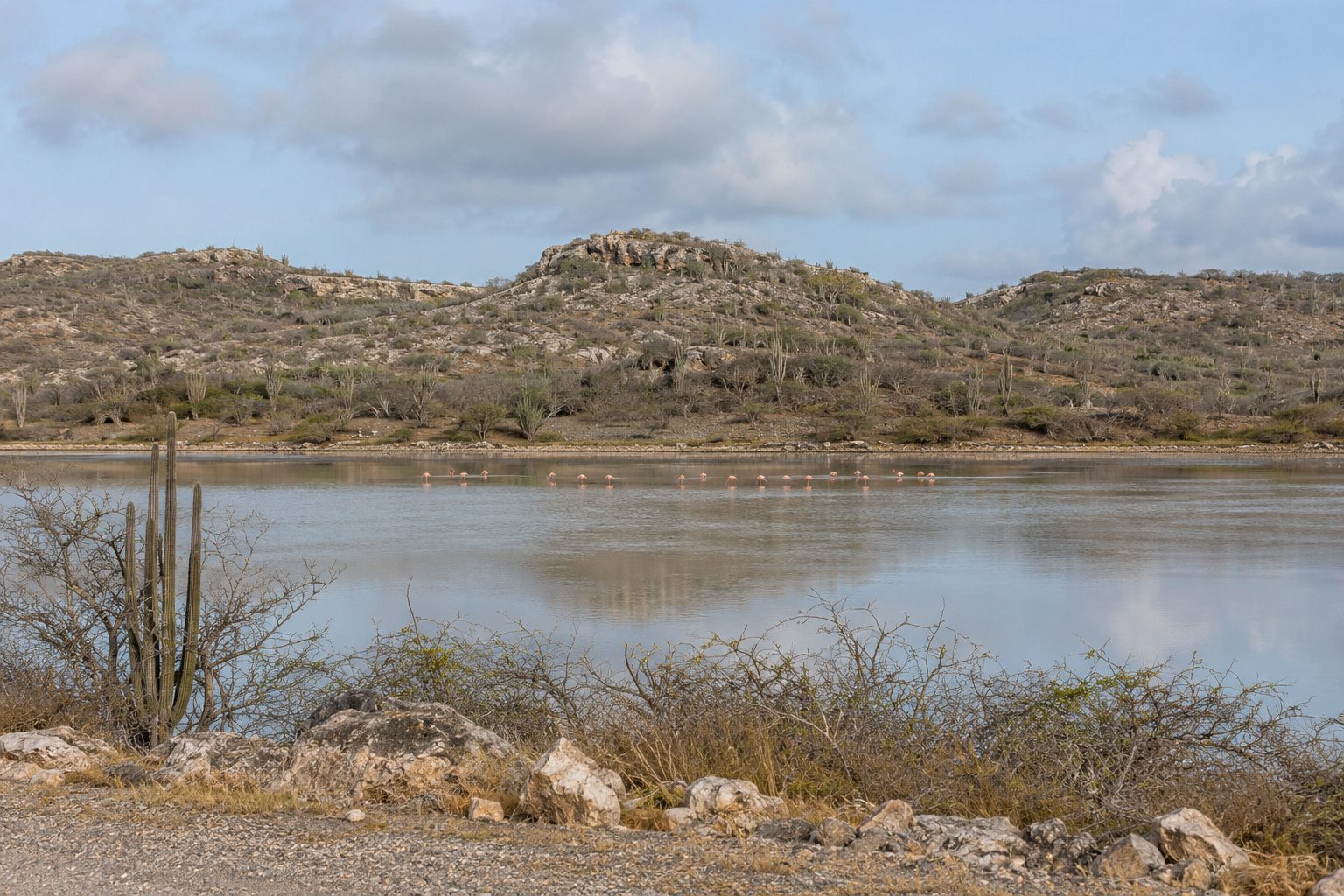
- Early morning: it is still cool, the water is often mirror-smooth and the light is soft.
- Late afternoon: the low sun brings out the pink of the birds and the salt pans.
- Midday: possible, but it is hot and the sun causes a lot of glare on the water.
Bring water, sunscreen and a hat. There is very little shade in the south, and you will probably end up watching longer than planned.
How to watch without scaring them off
Flamingos are shy. If they take off, you have already come too close. Every time a flock flies up, the birds lose energy they need for feeding or breeding. These are our rules of thumb:
- Keep your distance. Use binoculars or a telephoto lens instead of walking closer.
- Stay on the road or the verge. Do not walk along the dikes or shores towards the birds.
- Never walk into the water. Not even for that one perfect photo.
- Stop calmly in a safe place. Do not brake suddenly and never park in the middle of the road, because other traffic uses it too.
- No drones near the birds. A drone above a flock of flamingos will almost certainly make them fly off.
- Be quiet. Talk softly, close car doors gently and turn off loud music.
- Do not feed the birds. They find enough food in the saliñas.
The less the birds notice you, the longer they stay. You will also see more natural behaviour, such as feeding, preening and the famous flamingo dance.
Photographing flamingos without disturbing them
The pink salt pans make a good backdrop, and you do not need to get close for a good shot. A few choices give you better pictures from a distance.

- Use a telephoto lens or zoom. A smartphone with optical zoom also works surprisingly well.
- Use your car as a hide. Birds often react less to a parked car than to a person on foot.
- Look for reflections. On calm mornings the birds are reflected in the water.
- Photograph the flock. A line of flamingos against the horizon often tells more than a single close-up.
- Be patient. Wait for the birds to walk your way, rather than the other way around.
Flamingos in flight show the black and pink of their wings. Make sure that moment happens naturally, and never because of you.
Our tip: rent a car for flamingo watching on Bonaire
Bonaire has little public transport. To see flamingos in both the south and the north, a rental car is the easiest option. You decide when to leave, so you can be there in the early morning light, and you can stop wherever it is safe along the way. Book your rental car in good time, especially in high season.
Looking for a base for your island drives? Take a look at our Bonaire Beach Apartment 17 with communal pool and diving facilities. After a morning of spotting flamingos, you can cool off in the pool.
And put the camera down now and then. Listen to the soft honking and watch the flock wade slowly through the water.